Jun 22, 2012

Dark Chocolate & D Cups

Halle Berry.  Photo: Entertainment Rundown.
Checking out the audience at a recent Hollywood event, not a stray hair or scuffed Jimmy Choo in the house, it was striking to see a room of mostly Black women. 

They call themselves Dark Chocolate.

The SAG-AFTRA event, part sorority/part pep rally, was hosted by a group that is fighting Hollywood's pervasive stereotype of leading ladies:  big breasts, light skin, size zero.  Black women, especially those with dark skin and curves, barely stand a chance at being cast in starring roles. 

 "Name five dark chocolate women in romantic leads on TV or in movies," the host challenged. No one could. 

Industry figures show people of any color are hired for less than 15% of all roles. In fact, Hollywood remains one of the only places where hiring discrimination based on skin color, size or age is still legal.

One of Halle Berry's stunt doubles (looking even thinner than the 5'7," 123 pound Oscar winner) sat by me so we started talking.  "Halle gave me a chance and it grew from there," Eva (not her real name) said.

Eva encouraged me to consider stunt training after I mentioned my recent skydive (omitting all the shrieking). She said a good place to start is with precision driving, where skill matters more than skin color or breast size since the actual driver seldom gets screen time.

Realistically? Doors aren't going to fly open anytime soon for women like me.  But like Eva said, you just have to be ready when one does like it did for Halle's team - which even includes a MALE double. 
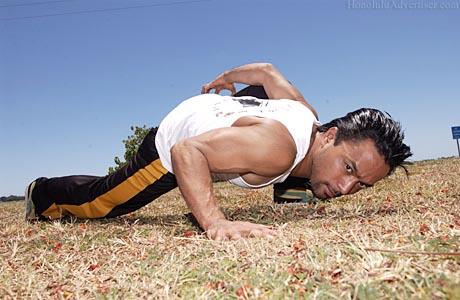
Halle Berry's Catwoman stunt double (The Honolulu Advertiser photo)
Yes, a MAN (Nito Larioza) performed many of Halle's sexy-fierce Catwoman moves!

Sometimes talent does triumph over fair skin and D cups.


www.facebook.com/shayholland

Jun 6, 2012

Freefalling!

say your prayers!
Every once in a while we experience that surreal moment when a dream becomes reality.  

Skydiving was one of those moments.  

I've wanted to go ever since I was a kid growing up on military bases where we'd watch the paratroopers train. 

Fast forward a few decades.  One of the deadliest natural disasters in history.  Haiti.  A team of strangers risking their lives to save others.

They're the kind of fearless souls who pull people from burning buildings. climb Mt. Everest. fight wars for our freedom. attempt feats most of us wouldn't dare.

At first I felt out of place.  They save lives; they know what to do with bloody wounds and cracked skulls.  Me?  I know what to do with a camera and a pen. 

But somehow we fit. 

And that's how skydiving came up.   We got the idea to jump as a way to raise funds for an orphanage.  Our Heights for Haiti jump fell through but two of us decided to go anyway.

Ironically, we were assigned to the same plane for our tandem jumps as a team of training soldiers.  As the plane climbed, they'd suddenly vanish out the open door, sometimes mid-sentence.  I thought my heart would fail each time. 

When my turn came, I looked into heaven and began...screaming.  "Oh!  My!  God!"  

Freefalling at 120 mph (experts say it's like floating, not a rollercoaster drop; I felt both) all I could do was pray. And scream. 

When we finally landed an eternity later (ok, about five minutes), the Skydive Arizona crew made me feel like a hero just for strapping on the harness.  

But the real heroes are the Haiti team and those who risk their lives for others - you are the courageous ones.

YouTube link of my jump! My favorite part is 2:24 when Chad jumps - and I realize I'm next. "Chaaaad! Oh my God!!" 

May 30, 2012

Almost Jump Time!

Three days until the big jump!  Of course, the news would keep showing video of the 80-year-old grandma's near fatal skydive when her harness malfunctions...*

Still, we're ready (my jump partner is an EMT I met heading to Haiti after the  earthquake).  I'm more worried about the heat. It's supposed to get up to 110 at the drop zone - could be trouble for someone used to 70 degree coastal temps.

Skydiving Magazine says freefall doesn't feel like the roller coaster drop most people expect so that makes me less nervous.  They say freefall is more like "a comfortable sensation of floating; the closest thing to human flight." 

So why skydiving?  I'm still trying to answer that question but maybe it just comes down to this:  adventure.  

Whether reporting in a disaster zone or caring for orphans in a Third World slum, adventure forces me to draw on my faith in ways ordinary life doesn't.  Away from our comfort zones, we're far more dependent on God and can sense a grace higher than any adrenaline rush.

Who knows, maybe facing fear opens the door for greater grace?  And grace always precedes great exploits.  

A demon-possessed man who lived in tombs?  Grace restored.  

A soldier whose ear got cut off ambushing Jesus?  Grace healed.  

A woman caught in adultery?  Grace forgave. 

And a grandmother who almost died skydiving?  Grace saved.

Grace and skydiving? Who knows.  In any case, I like what the thrill-seeking grandma said to a reporter who suggested safer hobbies: "Knitting is boring." 

***
Grandmother's near fatal skydive:

May 18, 2012

Slaying Giants

The long-awaited adventure is almost here!  Flights are booked.  Reservation is set.  Soon I'll be strapped to a stranger and hurling toward earth at 130 mph. 

The question people ask most is, "Why skydiving?"  What they mean is, "ARE YOU OUT OF YOUR MIND?!" 

"I seem to be missing the gene that says, 'This is dangerous, don't do it,'" I recently told friends in Haiti. 
Motorcycle taxi to the market in Haiti
They were trying to talk me out of riding a motorcycle taxi to the market.  The market wasn't far but motorcylists are often killed due to the lack of traffic laws and the fact that most don't own helmets or protective gear. 

Still, I was determined to experience this common Haitian method of commute; sometimes entire families, toting babies and bags, ride one motorcycle! 

So, armed with tips from our host on how to barter for mangos and pineapples, I eagerly climbed on the bike when the driver arrived.

In Haiti, drivers use whichever side of the road is open. I held my breath as we'd swerve back into our lane seconds from a head-on collision. I feared scraping the skin off my arms as we dodged through inches-wide openings between trucks. 

I soon quit trying to ride like the fearless Haitians and clasped both arms around my driver's waist as tightly as I could.

Two hours later we arrived back home without a scratch.  Mangos never tasted sweeter.

So why skydiving?  Like the motorcycle ride, I can't explain it.  I just know it's about slaying a giant:  Fear.  Like the biblical queen Esther, it has to do with destiny.  embracing faith.  I'm tired of being beaten by giants.  

Besides, look at Esther - she took a risk and it led to a throne.


www.facebook.com/shayholland

May 2, 2012

Free Beach

The Haiti you never see. 2012
I was stunned to learn on our recent trip that most Haitians have never been to the beach.  They live in a place once called The Jewel of the Caribbean yet they've never dug their toes in the warm sand or swam in the clear blue water.

"It's too expensive," our interpreter explained.  Most beaches are private and charge $20-30 a person to enter; the average Haitian earns $2 a day.

Our Haitian friends couldn't believe it when I showed them pictures of the California beach I walk to almost every day.  

"You just go down there?" they asked, unable to fathom such adventure cost nothing. "Anytime?"

Countless hours of the last 1,825 days have been spent at the ocean - playing,  dreaming, praying.  I've just hit the five-year mark in LA.

Hollywood's definitely been an adjustment for a girl who grew up with Big 10 tailgates, church potlucks and chivalrous men.  Here, they grow up with pools and pills; celebrities are worshipped more than Christ; and men?  Well, let's just say my friends and I can often tell the non-natives by their manners. 

I've thought about moving but so far have felt compelled to stay.  Maybe it's time for a change. 

I go to the beach to think.  The ocean seems to ebb and flow with an invitation to linger.  Thankfully it's free.


www.facebook.com/shayholland

Apr 12, 2012

Two Years After the Earthquake - Part 3

boys at an orphanage loving the bubbles we brought. Fabio Diniz photo
This is the third story about returning to Haiti two years after covering the earthquake.  For part 2, click here.

Today we're heading to the orphanage where our relief team stayed after the earthquake.  Finding the compound is tricky because many streets don't have signs.  Two years ago we had a tap tap (truck taxi) driver to guide us but now we're on our own.

An orphanage worker had told us, "turn right at the old rundown shack with a water hole in the ground with a tire over it."  Dane thinks we missed the turn a half-mile back but I can't tell.  While the rubble and UN trucks are gone, dilapidated huts and abandoned tires litter almost every block.

We're not far off course and soon find the bright teal gates just as we remembered.  New Life Children's Home.

As the armed guard lets us in, we see the mango tree!  We'd spent hours talking, eating, praying in that spot.  The last time we were here, tents had covered the soccer field that we had turned into a base camp but now the field is lush and green.

A staff member greets us in English, "The kids will be so happy to see you." Most of the kids are in class but the toddlers are outside playing.

Kevin!  He was a starving newborn who slept holding my thumb the last time I saw him.  Now he's a healthy two-year-old with a  round belly who carries himself like a ringleader in diapers. 
Kevin and John, now thriving at two, were starving orphaned infants when we met them.

"When you were born," I demonstrate rocking an  infant in my arms, "I took care of you," I say pointing at Kevin.  He seems to think I'm calling him a baby and stomps off to get a toy truck.

Playing with the other kids, I try to coax a gaunt-looking boy to join us. Before I can stop him, he rips a piece off a plastic mat and eats it.  Still afraid of starving, I guess.


A mom waits
Staffers take the kids inside for naps. A young, White woman comes for John who had been rescued from the mountains after the quake.  "I'm his mom,"  she says in English.  She's living here waiting for the government to approve her and her husband's adoption paperwork.

As we talk, she mentions wishing they had baby pictures of John.  "Is the Internet working?"  I ask.  Nurses on our team had taken the first pictures of John two years ago.  Amazingly, I'm able to download several Facebook photos on to her laptop.

Before leaving I pray with this mom who refuses to leave her son, knowing that in Haiti it can take two years to bring a child home.

Barefoot boys
Later, our host drives us to a Haitian orphanage.  "It won't be like the American one," he warns.  We come to a small, concrete building that can only be reached by climbing a steep hill.  Instead of mango trees and a grassy field, we're met by barefoot boys playing soccer in a concrete entryway that's smaller than most American closets.
Dane Melberg photo
The kids don't wait for the pastor who runs the orphanage to introduce us, instead they grab our hands and lead us inside.  As we break out stickers and bubbles we've brought from the US, the kids erupt in joyful shrieks, giggles and laughter.

The tiniest child, Samuel, wants to chase bubbles with the other kids but he's so frail his bones might break if one of them accidentally steps on him.  I pick him up and let him help me blow bubbles.  Our host says Samuel wasn't expected to live, suffering from TB and starvation.  The three-year-old's hands seem much too big for his body; he weighs no more than an 18-month-old baby.

The kids climb on Dane like a human jungle gym as he tosses them over his head.  Samuel wants Dane to toss him in the air, too.  It's too risky, though, in case he falls.  But how can we say no to a child who just wants to play?  Dane gently lifts a beaming Samuel over his head as the other kids laugh and cheer.

It's hard to say goodbye. The pastor closes the gate and walks us down the hill to our truck.  I still have Samuel in my arms.  I want to drive away with him, just to keep feeling his heartbeat...
little Samuel leaning on my shoulder
"A child here in Haiti would probably trade whatever toy you give them for five minutes on your lap with your arms around them." ~ Patty Meyer, New Life Children's Home

www.facebook.com/shayholland

Apr 4, 2012

Two Years After the Earthquake - Part 2

Haiti 2012 (Sarah Batista photo)
This is the second story about returning to Haiti two years after covering the earthquake.  For part 1, click here

Stormy night
Tropical storm!  The downpour sounds like it will rip through the tile roof of our host's home.  I can't help but think about the families living in tents - just tarps  and sheets, really - that have been their homes since the earthquake.

In the two years since the disaster, the government has moved the larger tent camps to the hills outside Port-au-Prince but smaller ones remain.  Families living amid the stench of rotting garbage; women bathing in plastic tubs of dirty water; children playing in waste-contaminated mud...

I feel a twinge of guilt at our own comfort but mostly gratitude that we're in a dry place; sleeping outside would have been miserable.  The weather had been mercifully clear when our relief team camped on a soccer field after the earthquake. 

At least the storm quiets the roosters that normally crow all night.

Rebuilding
By morning the roads are passable.  We drive to a site where a pastor started an outdoor church for residents of a tent camp. Our host's organization, Brazil-based MAIS, had heard of the congregation's plight and helped buy land for a building.

At the construction site, teenage boys push wheelbarrows filled with stone; gray-haired women carry water buckets; children shovel dirt with toy pails.  The workers are mostly congregation members who volunteered to help build the church; only a few skilled laborers and an American project manager are paid.
Building a church for residents of a tent city
Learning to carry water
"Have the women show you how to carry water," the project manager tells me. I follow two women to  a cistern and ask for a bucket in English but they only speak Creole.  Empty-handed, I walk back to the site.

"Come with me," says the interpreter, Schneider. His flawless English and breezy style, iPod headphones draped around his neck, remind me of a California skateboarder.

"You use this," he rolls a dirty cloth into a tight donut.  "It keeps the bucket in place," he explains, slapping the wet rag on my head.

At the cistern, I lower the dip pail but it keeps bobbing like a sailboat so I can't fill it. Schneider shows me how to skim the pail so it tips and takes in water. He tells me to stop when the bucket is half full.  "Since this is your first time, it will be heavy and slosh," he says. 

Next time I fill the bucket to the rim. "You carry it a little way and then I'll take it," Schneider says, "You might hurt your neck."  The 40-pound load hurts but I decide to keep going. Seeing the American woman carrying a full bucket on her head, the workers break into applause.  Success!
Our interpreter Schneider shows how to carry a bucket (left).  Success! (rt)

"Here," the pastor says, handing me a Styrofoam container. "You get lunch because you carried the bucket of water."  The crew laughs as we dig into rice and beans washed down with cold Coke and 7-Up.

We spend the afternoon shoveling stone and dirt.  Despite the heat and hard work, laughter fills the air.  The men tease eachother and trade funny stories, acting them out in a mix of Creole and English.

More storms
That night another storm pounds the island.  I think about the families living in the tent camps.  I fall asleep thinking, They have a joy no storm can wash away, no disaster can shake, no man can destroy.  Maybe they are the fortunate ones.

To read part 3, click here.


www.facebook.com/shayholland